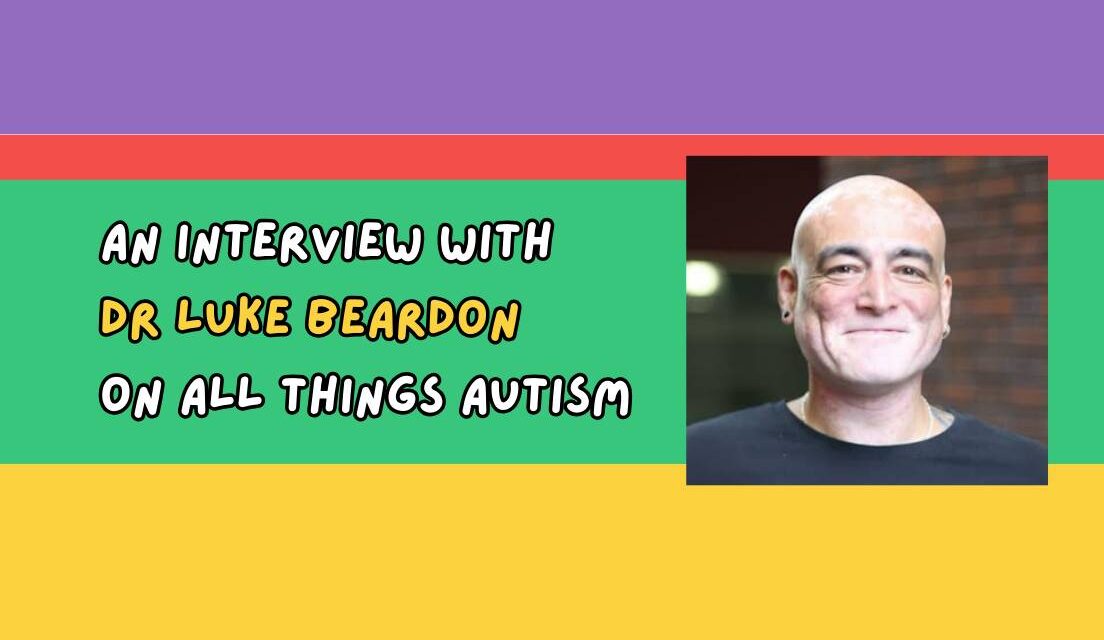
Earlier this week, I met with Dr Luke Beardon, the senior lecturer of Autism at Sheffield Institute of Education to find out more about his passion for autism and learn about his extensive work in the field.
Luke is a staunch advocate of autistic individuals’ rights, has written numerous successful books on autism and has won multiple autism-related awards, as well as several inspirational teacher awards. Luke often speaks at National and International conferences sharing his passion for all things autism related.
Where it all began
With such a deep specialism, I was interested to find out where Luke’s interest began. “When I was 14 years old, we all had to do community work at school. I volunteered at a school called the Windmill School, in Cambridge, which was for little kids who had additional needs, most of whom were autistic. And I just fell in love and never looked back. I sort of felt at home for pretty much the first time in my life.”
As Luke has worked in the autism field for over 3 decades and published eight books, I asked Luke whether his interest had changed at all. Luke shared that although, every six months, he might wake up and debate a career change, by lunchtime he’s usually changed his mind and is happy with the field he is in. “My focus has always been autistic wellbeing and whatever tiny part I might be able to play in promoting autistic well-being, that’s my goal really.”
However, he does feel the autism field itself has changed over the years, but that the progress made has been gradual and not as quick as he would like.
Autism + environment = outcome
Luke is well known for his model ‘autism + environment = outcome’, which he came up with because he was tired of professionals deciding what the future held for autistic people. Whether it was assuming that autistic people wouldn’t get a good job or have strong interpersonal relationships, he questioned how they could possibly know this without a crystal ball. “Being autistic,” he told me “doesn’t automatically lead to anything apart from being autistic. But we also know that there are clear trends when it comes to outcomes such as an increased risk of poor mental health, decreased risk of gainful employment and so on. But why is that? Because being autistic doesn’t mean you can’t have a job or that you’re automatically mentally ill.” Luke explains that this is how he came up with his “self-professed golden equation.”
“If we agree that you can’t change somebody being autistic (which you can’t),” he goes on to explain, “then what we should be doing is focusing on the environment. Far too often, the onus of responsibility is always on the autistic person needing to change, conform, or adapt.” Whereas, if we say let’s change the environment to fit the autistic person, then the outcomes should improve.”
Environmental adjustments that can make a difference
On the subject of adjustments, I asked Luke for some examples on what can make the biggest positive impact on outcomes. He expresses that adjustments are very individual but that “access to a safe space, time and authenticity are fairly universal. (I like things in sets of three),” he laughs.
While neurotypical people are often able to access those things without much thought, he tells me that those same things are often not afforded to autistic people. “Often, autistic people don’t feel safe much of the time. They don’t have time to feel safe, and don’t get the opportunities to develop their own authenticity, because almost on a day-to-day basis you get told, no, that’s not good enough, you need to change.”
Be careful what you read and who you listen to
I share with Luke that I have a close family member who is seeking an autism diagnosis and ask if he has any advice for a newly diagnosed person or a parent who suspects their child may be autistic. He tells me that you must be “really careful who you listen to, who you tell and what you read” and about a concept he calls ‘autistic epistemology’.
Where does so-called perceived autism knowledge come from, he asks, “because a lot of what you’re going to read is potentially misleading or downright false”.
“A lot of what people read and are told”, he states, “is that being autistic means this or that, but they don’t know you, they’ve never met you and they’ve never met your child.”
On a recent podcast Luke was featured on, he shared about a desire that every person who works in the autism field, would relinquish all prior knowledge of autism every time they met a new autistic person. “It’s what I try and do,” he shares, “because otherwise you fall into this trap of thinking oh yeah, I know a bit about autism because I’ve known an autistic person, and then you apply that knowledge going forward. But actually, you don’t know anything about them apart from them being autistic.”
The complexity of media portrayals of autism
While it’s clear there are a lot of assumptions made about what an autistic person is like and what they can or cannot do, I was curious to hear Luke’s opinions on media portrayals of autistic characters. Often the media is guilty of mispresenting certain groups in society, falling into negative stereotypes and oversimplifying complex things.
“I’ve got a bit of a love-hate relationship with media portrayals,” he admitted. “Part of me gets frustrated when people say that a media portrayal is rubbish and nothing like me. And yet at the same time, we’re saying everybody is an individual. But there is a responsibility on the media to not perpetuate mythical stereotypes. I think there should be a greater responsibility on filmmakers and TV producers to do more consultation work with autistic people.”
Luke fondly shares that he prefers written portrayals like The Rosie Trilogy, “It’s very nuanced, very balanced and very lovely.”
He adds that he’s very fascinated by characters that aren’t explicitly shown as being autistic but have you wondering if they were based on a person with autism. His example is Luna Lovegood from Harry Potter.
Autistic people and hyper-empathy
One of the misrepresentations that comes up a lot in the media is the idea that autistic people lack empathy. However, anyone who knows someone who is autistic will know that often autistic people are very empathetic. Luke agreed and had a lot of thoughts on this.
“Going back to autistic epistemology,” he shared, “a lack of empathy is one of the one big myths. But it’s clear when you talk to almost anybody in the autism community that this idea is a complete misnomer.” He then goes on to highlight that there are different types and presentations of empathy.
“And everybody lacks empathy to a certain degree. We can’t all care about every other human on the planet. It’s not possible. Be it for an animal, for an inanimate object, for a human being or for a group of people. We know categorically that there’s lots of displays of hyper empathy amongst autistic people and it breaks my heart. I think it’s one of the most damaging myths out there that we are cold and unfeeling.”
3 tips for loved ones of an autistic person
When you don’t have lived experience, it can be difficult to know how to support someone. It can also be hard for someone to tell you what they need. I asked Luke if he had any suggestions for how the loved ones of an autistic person can show up for them.
1. Trust
“Trust is the biggest one,” he told me. “A trusted human is possibly one of the most gorgeous things you can give your autistic loved one.”
2. Letting them be themselves
“Not judging them against a lens that’s inappropriate to them but, doing the best you can to understand their lives through the autistic lens. Often people are making assumptions based on a predominant neurotype lens, and you just can’t do that.”
3. Believe what they say
Tying into his point about trust, it’s important for loved ones to “believe in what they say, however outlandish that might seem.” He goes onto share that often, autistic people have been masking for a long time, so when that mask comes down, it can be different to what people are expecting. “It’s so tempting to be like, well, I’ve known you for 10 years and you’ve been like that for 10 years. Now all of a sudden you’re saying this so that can’t possibly be you.”
If someone tells you something and shows you who you are, believe them because in Luke’s words, “it’s incredibly vulnerable to expose your brain to someone.”
Thank you to Dr Luke Beardon
A huge thank you to Luke for taking the time to meet the YES team and chat about all things autism. It was such a fascinating conversation with tangible advice and insight for both autistic people and those around them. Something I will definitely personally take away from our interview.
We’re also very excited to have Luke join us to celebrate Neurodiversity Celebration Week (16-20 March) and to have him host a free webinar ‘Autopia’ (a vision for autistic acceptance and belonging in a future dimension). There are also lots of other free events taking place that week, including other webinars with key note speakers, plus a big in-person community event at the Towner Art Gallery and Cinema on Friday 20 March.
Come join us for Neurodiversity Celebration Week and make sure you sign up to all the events you’d like to attend – places are filling up quickly and we don’t want you to miss out!